TRIMINGHAM BEACH Revisited 2026
It`s that time of the year again for the annual beach report and this is the current state of things with Trimingham beach and cliffs. With the majority of the spring and summer being very dry, surface water issues have not had the same effect on the state of the cliffs as last year. However following a wet spell in November and December the ground water has now started to permeate through in many places, especially in the area at the old Crown & Anchor site and to the west of Trimingham House caravan site. The last storm in December, named Gereta, also produced strong north-easterly winds and this lowered the beach levels all along the coast and the beaches here at Trimingham remain low now, exposing much of the old defences.
Previously I have mentioned two springs flowing from the cliff below Beacon Hill, there are now three. This is good as it means the ground water is flowing out and causing less cliff falls.
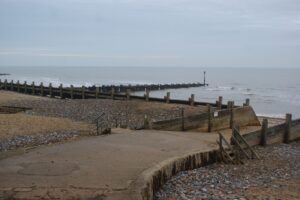
At the gangway and a high beach behind the revetment, but the main beach is down to the metal sheet piles on the other side. This is the same for much of the beach, but as you head towards Trimingham most of the beach material is not retained behind the revetment, and the sea reaches to the base of the cliff taking away any fallen material.
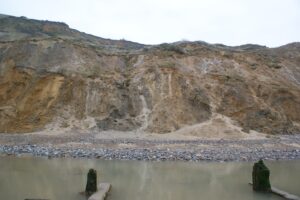
Just to the west of Trimingham House caravan site and surface water continues to drain from the cliff here. There is a very sandy layer here and the whole area appears unstable. There was a large fall here in 2019, an area the size of a football pitch slipped to the beach breaking away a large section of the revetment. All of the fallen material has long been washed away.
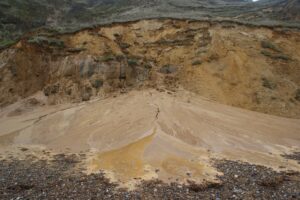
More surface water in the same area.
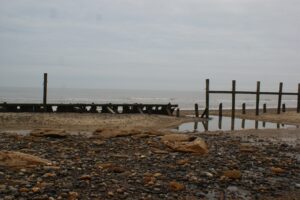
The next section of beach and here there is not much of the revetment left. Every high tide sees the sea reach to the cliff base and the toe of the cliff is continuously washed away.

Freshly fallen cliff and all of this will be washed away as the revetment is all but gone on this section of beach. This is the situation from here through to the Beacon Hill area where some of the revetments still remain.

The beach and cliff below Beacon Hill. The erosion process can clearly be seen here, as each high tide takes a little more from the cliff base, the cliff above collapses, and the loose material is washed away. On the left is a pool left by the receding tide, the revetments have little effect at stopping the waves from getting to the cliff base, but it does provide a good spot to find the odd fossil!

Below the Dale and Sea House, the distance is now about 45mts between the old defences and the cliff base! Ground water continues to seep through in much of this area.

Behind the concrete defence and the beach material is continually washed away as the west to east flow of the flood tide races along behind. It is only the old wooden posts and the metal sheet piles on the sea side that support the concrete and these have failed in many places with the concrete now collapsing.
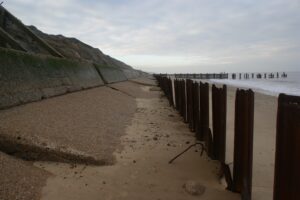
On the sea side of the defences, and without the support of any beach, the concrete is collapsing with the metal sheet piles left standing.
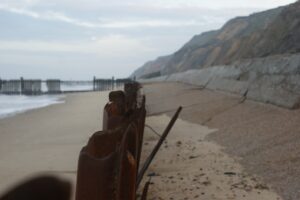
More sections of the concrete that are collapsing.
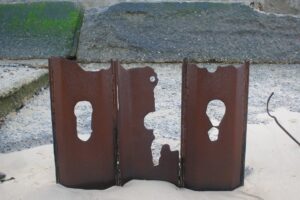
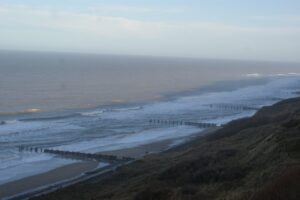
The view from the cliff top, and the deterioration of the timber groynes can clearly be seen. The tide flow is funnelled, parallel to the beach, between the chalk reef just offshore and the concrete defences. This has the effect of scouring away the beach and the timber piles are continually worn by the abrasive action of the sand and tide.
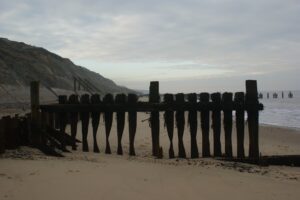
At the beach and the abrasive effect of the sand on the timber piles!
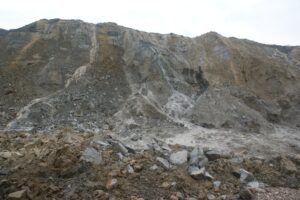
This is directly below the old Crown & Anchor site, with the pond which has formed here on the cliff, draining over the edge.
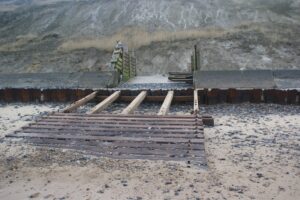
Below Pilgrim Shelter and the remains of the once planned access point.
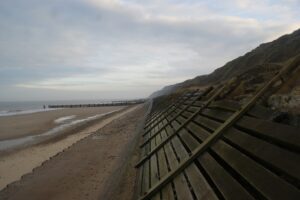
The last 150mts of revetment at the western end of the beach which remain largely intact and with the concrete is still in place, apart from at the very end where another access point was planned, and this continues to be damaged and broken up by the wave action.
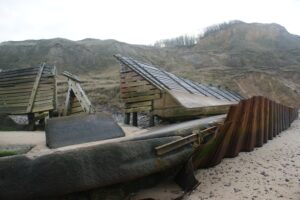
At the end of the defences, eventually the sea will get behind here and the intact piece of revetment will be damaged and broken with the stable cliffs here eventually being at risk!
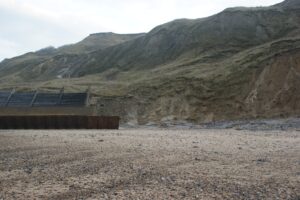
The very western end of the revetments, and as previously mentioned, it is only a matter of time before the sea gets behind here and starts to erode behind the only remaining intact piece of the defences.

At the very western end of Trimingham beach and the old marker buoy is still present, although a lot more corroded than in previous years. The buoy was completely buried in sand for most of the summer and was only exposed recently following storm Gereta in December.